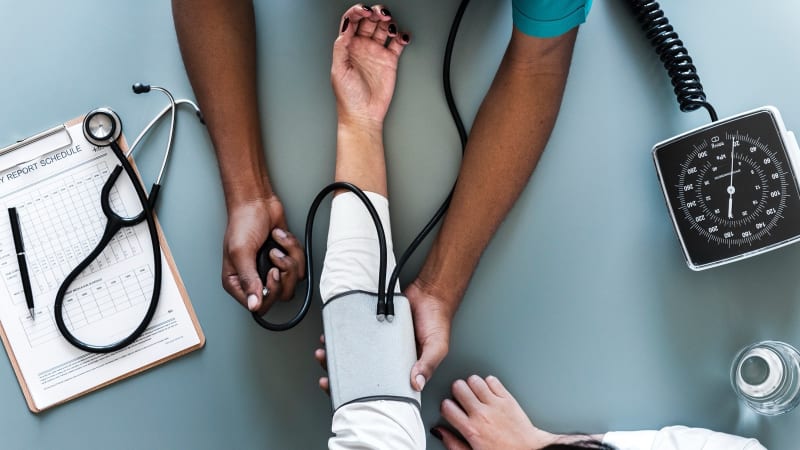
The short answer: use an automatic upper-arm monitor, sit quietly for five minutes first, rest your arm at heart level with the cuff on bare skin, take two readings one minute apart, and do it at the same times each day. Write the numbers down and share them with your doctor.
High blood pressure rarely causes symptoms, which is why so many people do not know they have it. The World Health Organization estimates that 1.4 billion adults aged 30 to 79 had hypertension in 2024, and that 44% of them were unaware of it. Measuring at home is one of the simplest ways to find out and to keep track.
Which blood pressure monitor should I buy?
The American Heart Association (AHA) recommends an automatic, cuff-style monitor that goes on the upper arm. It does not recommend wrist or finger monitors because they give less reliable readings.
Two more things to check:
- Validation. Choose a monitor that has been validated for accuracy. If you are unsure, ask a pharmacist or your doctor.
- Cuff size. The cuff must fit your arm. A cuff that is too small or too large gives an inaccurate reading.
Before you measure
According to the AHA:
- Do not smoke, drink caffeinated drinks or exercise in the 30 minutes before measuring.
- Empty your bladder.
- Sit quietly for at least five minutes first. Do not talk or use your phone.
Step by step
- Sit down and get comfortable. Remove any clothing covering the arm you will use.
- Support your arm on a flat surface such as a table, so that the upper arm is at the level of your heart. Use a pillow under the arm if you need to.
- Place the cuff on bare skin, with the bottom edge just above the bend of the elbow.
- Stay still and silent while the machine measures.
- Take two readings, one minute apart.
- Write both down with the date and time, or save them in your phone.
You can use either arm. There is usually little difference between the two.
When and how often?
Measure at the same times each day. The NHS describes a typical home routine as twice a day, once in the morning and once in the evening. Your doctor may ask for a week of readings before making any decision, because a single measurement tells very little.
What do the numbers mean?
A reading has two numbers. The top number (systolic) is the pressure when the heart beats. The bottom number (diastolic) is the pressure between beats.
- WHO defines hypertension as 140/90 mmHg or higher, confirmed on two different days.
- The NHS uses 140/90 or higher for readings taken by a healthcare professional and 135/85 or higher for readings taken at home, because people are usually more relaxed at home.
- The AHA classes a reading below 120/80 as normal.
Guidelines differ slightly between countries, so let your doctor interpret your numbers in the context of your age and health. A diagnosis should come from a health professional and not from one home reading.
When is a reading an emergency?
The AHA advises that if your reading is suddenly higher than 180/120, you should wait at least one minute and measure again. If it is still that high, contact a healthcare professional promptly.
Go to the nearest hospital immediately if a reading above 180/120 comes with any of these: chest pain, shortness of breath, back pain, numbness, weakness, a change in vision or difficulty speaking. Online consultation is not the right place for this situation.
Common mistakes
- Measuring straight after climbing stairs, eating or an argument.
- Putting the cuff over a sleeve.
- Letting the arm hang down instead of supporting it.
- Talking during the measurement.
- Taking one reading and acting on it.
Frequently asked questions
Can a doctor use my home readings in an online consultation? Yes. A record of home readings is useful information for a doctor reviewing your blood pressure, and it is one of the things worth having ready before a video consultation.
I feel fine. Do I still need to check? Yes. Most people with high blood pressure feel nothing, which is why checking matters.
Should I stop my medicine if my readings are normal? No. Do not stop or change blood pressure medicine without speaking to your doctor. Normal readings often mean the treatment is working.
Read more about hypertension and how it is managed, or book an online consultation to go through your readings with a Nigerian doctor.